COMMA POEMS—A MODERNIST IDIOM
Jose
Garcia Villa (1908-1997) is a luminary poet of the Philippines. He is acknowledged
as a notable man of letters both in his country, where he retained his
citizenship throughout his life, as well as in the United States, where he chose
to live and work for 67 years. He was honored as a National Artist of the
Philippines for Literature in 1973, among numerous other awards, honors, and
grants.
Villa has
been featured in noteworthy publications.
Together
with Jose Rizal and Nick Joaquin, he was one of only three Filipino poets
included in World Poetry: An Anthology of Verse from Antiquity to Our Time (1998),
edited by Katharine Washburn, John S. Major, and Clifton Fadiman. Encompassing
4,000 years of poetry until the late 20th century, the anthology compiles in
one volume over 1,600 poems originating from various languages and cultures
around the world.
In 2008
Penguin Classics published Doveglion: Collected Poems, Villa’s complete
poems, edited by John Edwin Cowen and with an introduction by Luis H. Francia.
The
website of the National Commission for Culture and the Arts (NCCA) of the
Republic of the Philippines says the following about the National Artist:
“Jose
Garcia Villa is considered as one of the finest contemporary poets regardless
of race or language. Villa, who lived in Singalong, Manila, introduced the
reversed consonance rime scheme, including the comma poems that made full use
of the punctuation mark in an innovative, poetic way. The first of his poems ‘Have
Come, Am Here’ received critical recognition when it appeared in New York in
1942 that, soon enough, honors and fellowships were heaped on him: Guggenheim,
Bollingen, the American Academy of Arts and Letters Awards. He used Doveglion
(Dove, Eagle, Lion) as pen name, the very characters he attributed to himself,
and the same ones explored by e. e. cummings in the poem he wrote for Villa
(Doveglion, Adventures in Value).”
https://ncca.gov.ph/about-culture-and-arts/culture-profile/national-artists-of-the-philippines/jose-garcia-villa/
—“Order of National Artists: Jose
Garcia Villa,” National Commission for
Culture and the Arts
The
Academy of American Poets website acknowledges Villa’s significance in Anglo-American
literature. Besides citing his honors and awards, the Academy observes:
“[In New
York City Villa] became the only Asian poet in a community that also consisted
of E. E. Cummings, W. H. Auden, and other modernist poets. In 1933 his Footnote
to Youth: Tales of the Philippines and Others (Charles Scribner’s Sons)
became the first book of fiction by a Filipino author published by a major
United States-based press.
“Villa
also continued to publish in the Philippines, and his poetry collections
Many Voices (Philippine Book Guild) and Poems (The Philippine
Writers’ League) appeared in 1939 and 1941, respectively. In 1942 he published
his first poetry collection in the United States, Have Come, Am Here
(Viking Press), which was a finalist for the 1943 Pulitzer Prize. He went on to
publish several more poetry collections in the Philippines, including Poems
in Praise of Love (A. S. Florentino, 1962), and two in the United States, Selected
Poems and New (McDowell Obolensky, 1958) and Volume Two (New
Directions, 1949).”
https://poets.org/poet/jose-garcia-villa
—“José Garcia Villa: 1908 – 1997,”
Poets.org
U.S.-based
Kaya Press declares, revealingly:
“At the
height of his career, Villa’s writings earned him prizes, fellowships, and
lavish praise from some of the greatest literary luminaries of the day. Yet his
work has been out of the public eye for more than thirty years and out of print
for more than fifteen. Although named a National Artist in the Philippines
where he was born, Villa remains largely unknown in the United States today.
“Kaya’s
republication of Villa’s writings both recovers and rediscovers the work of
this fierce iconoclast for a new generation. Included are reprints of his major
poems and representatives from each of his significant experiments, as well as
short stories and non-fiction work.”
https://kaya.com/authors/jose-garcia-villa-jose-garcia-villa-jose-garcia-villa/
—“KAYA PUBLISHES BOOKS OF THE
ASIAN PACIFIC DIASPORA: José Garcia Villa,” Kaya
Press
Kaya Press
refers to Villa’s republished writings in The Anchored Angel: Selected
Writings (1999), edited by Eileen Tabios and with a foreword by Jessica
Hagedorn.
Villa’s career
coincided with the rise of modernism, which robustly developed at the beginning
of the twentieth century and throughout the 1930s. Modernism definitively
declined in the late 1960s when it segued into postmodernism. In the literary
arts of the West, modernism concluded earlier than in the other arts, declining
in the 1940s and 1950s.
It would
appear that Villa, who is best understood as a modernist Filipino poet writing
in English, rode the cultural wave of modernism in the West, so that his public
profile diminished when modernism in literature, itself waned.
In May
1949 Villa published a group of seven poems, which he called “comma poems,” in Horizon
magazine wherein he introduced a poetic innovation by inserting commas between
each and every word in the poem.
In “A Note
on the Poems,” he explains:
“The
reader of the following poems may be perplexed and puzzled at my use of the
comma: it is a new, special and poetic use to which I have put it. The
commas appear in the poems functionally, and thus not for eccentricity;
and they are there also poetically, that is to say, not in their prose
function. These poems were conceived with commas, as ‘comma poems’, in
which the commas are an integral and essential part of the medium: regulating
the poem’s verbal density and time movement: enabling each word to attain a
fuller tonal value, and the line movement to become more measured.
“…I realize
of course that this poetic employment of the comma is an innovation which may
disconcert some readers.”
In the
context of modernism as a cultural movement, this particular innovation of
Villa may be interpreted as a historical iconoclastic repudiation of poetic
convention.
Villa’s
innovation has not always been well-received. At its best, it is an attribute
that augments the artist’s intended poetic effect. At its worst, it is
pretentious and farcical, falling flat.
Thomas
Dorsett, Villa’s astute critic and onetime student (1967-72), said of Villa’s
comma poems:
“José does
use the comma as a virtuoso, sometimes to great effect, but the eye sometimes
fatigues from all those commas. In the best examples, the commas significantly
increase the wonder of the poem; in the worst, this new use of commas seems
rather too clever and precious.”
—Thomas
Dorsett, “The Poetry of José Garcia Villa,” Spring: The Journal of the E. E.
Cummings Society (2007), Volume 16, Article 17, page 174
In at
least two published poems I used some adaptation of Villa’s “comma poem”
innovation:
“Jeepneys:
To Vicente Manansala”
https://poetryofgonzalinhodacosta.blogspot.com/2016/08/normal-0-false-false-false-en-ph-x-none.html
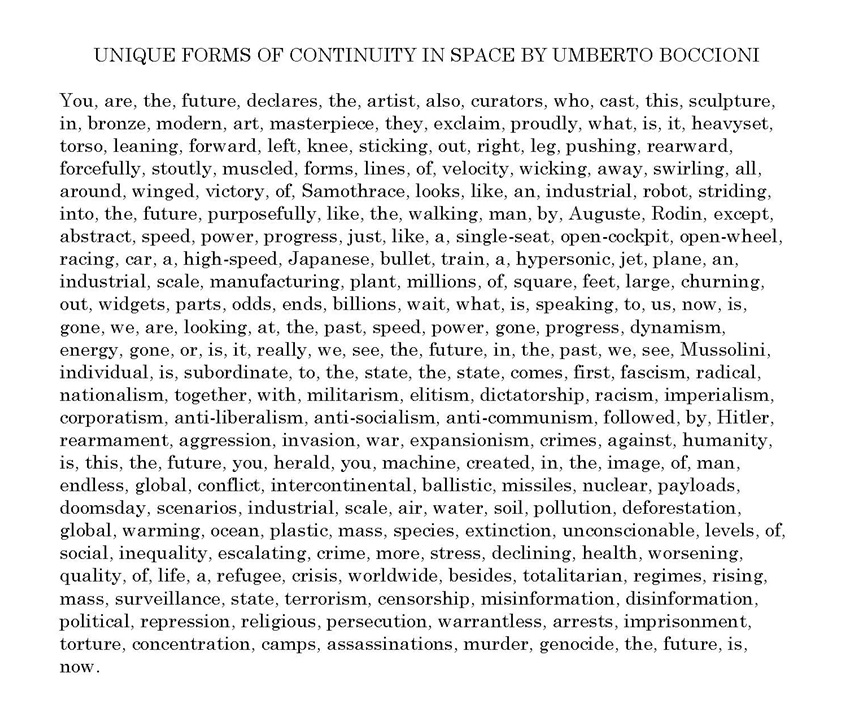
“Unique
Forms of Continuity in Space by Umberto Boccioni”
https://poetryofgonzalinhodacosta.blogspot.com/2023/09/unique-forms-of-continuity-in-space-by.html
I resorted
to Villa’s eccentric technique for at least three reasons.
First, my
poems are both written as ekphrases of modernist artworks. In seeking a
suitable idiom for the ekphrases, I sought the same modernist character that
defined the artworks. Because the “comma poem” format is a modernist idiom, I
found it suitable.
Second,
the “comma poem” format imparts an abstract, stop-start quality to the poem. In
a comma poem, written or spoken language is broken up by the commas and then reconstituted
to give rise to newfound, unconventional meanings. A comma poem does not communicate
in a conventional way. It generates unexpected, eccentric meanings.
In
addition, the process of breaking up conventional, often realist visual construction
and afterwards reconstituting it belongs to the process of abstraction in the
visual arts, so that the comma poem recapitulates this process.
The
stop-start character of the comma poem also recapitulates analogous abstract
elements in the visual artwork. “Jeepneys: To Vicente Manansala” does so, for
example, when the poem repeats, analogically, as it were, the stop-start quality
of Manansala’s energetic brushstrokes.
Not as felicitous
in recapitulating visual abstraction is “Unique Forms of Continuity in Space by
Umberto Boccioni” (the poem), because Boccioni’s masterpiece is characterized
by smoothly flowing contours, not so much by abrupt interruptions.
On the
other hand, Boccioni’s sculpture demonstrates a stop-start character when, for
example, the strapping figure’s surface sharply wicks away.
The
stop-start quality of the verses also recapitulates the stop-start quality of
stream-of-consciousness, which is modernist.
A final
reason why I resorted to Villa’s eccentric innovation in my poetry is to simply
honor him. Not only do I recognize that literary excellence abounds everywhere,
I am willing to acknowledge it. Imitation is the sincerest form of flattery
(popularly attributed to Oscar Wilde).